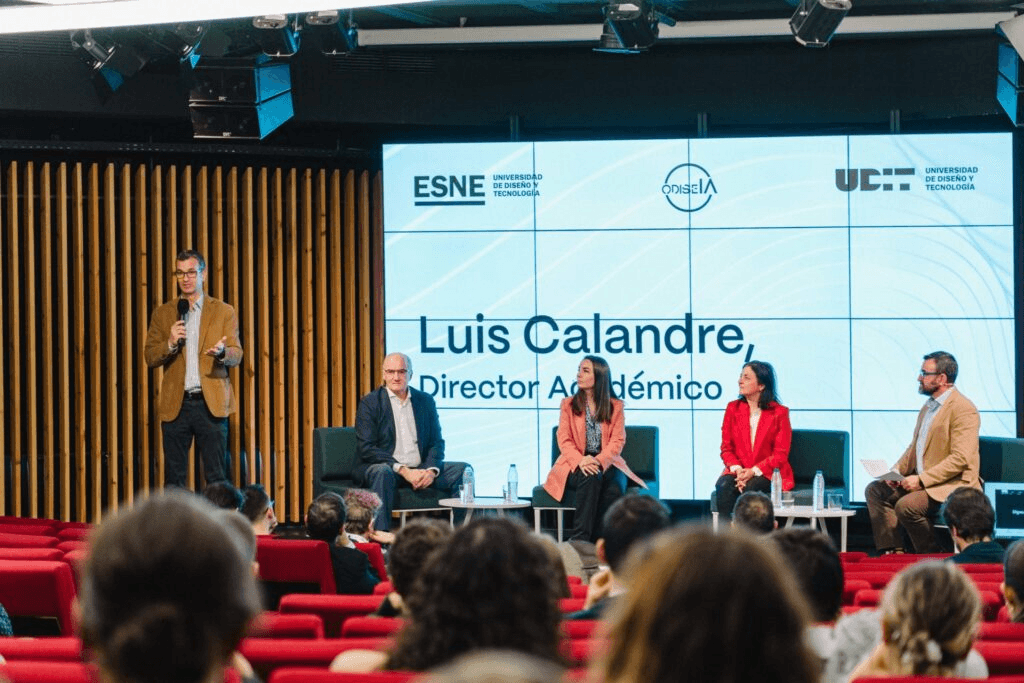
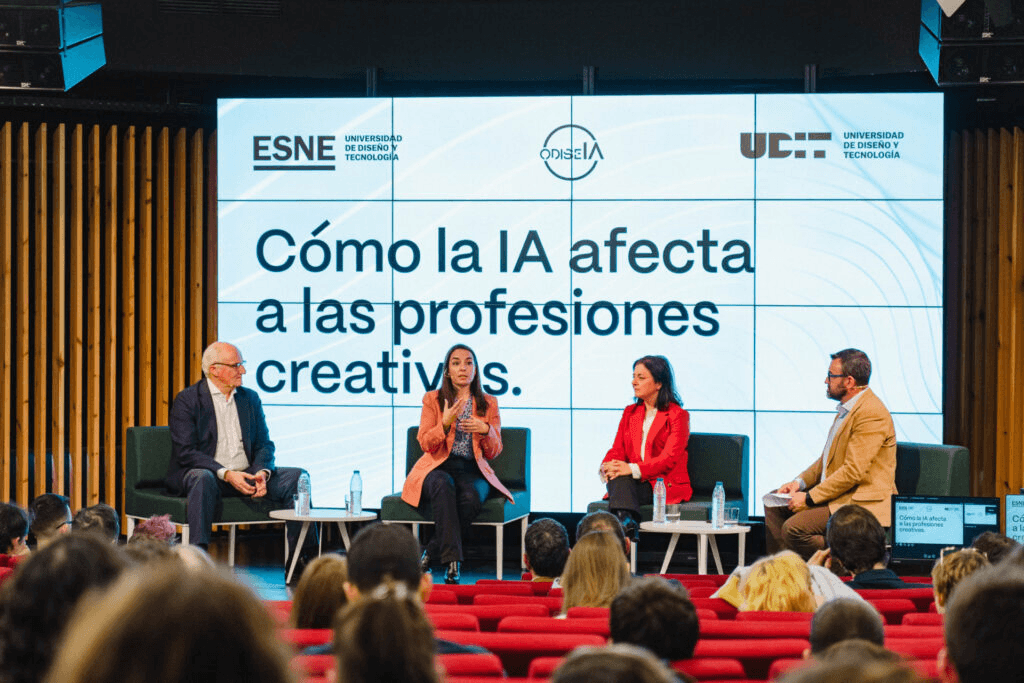
Round table "How Artificial Intelligence affects the creative professions".
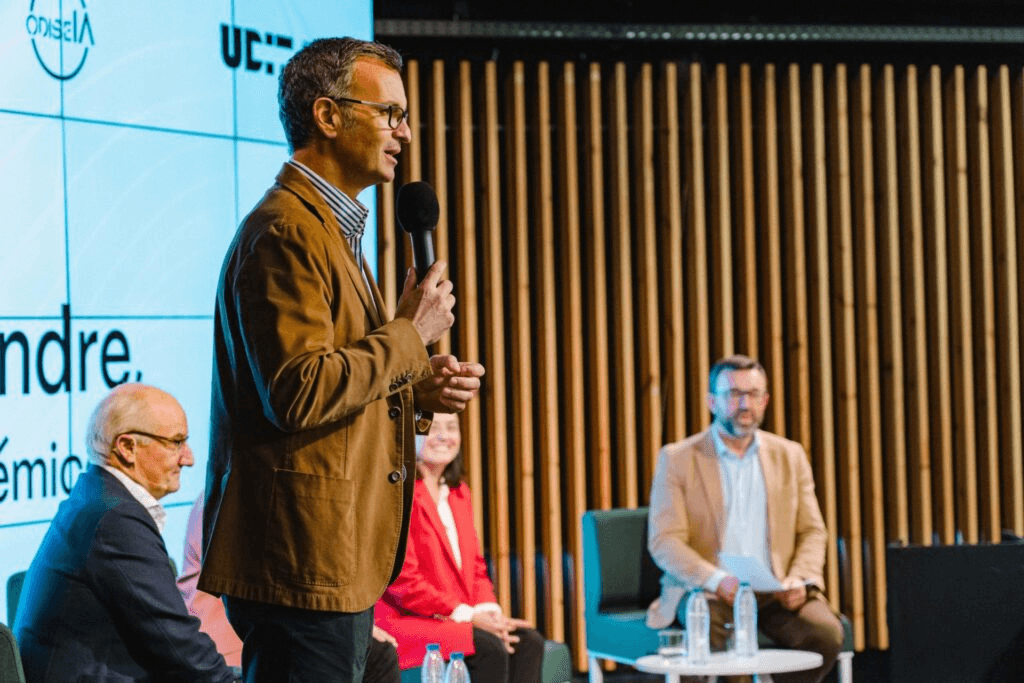
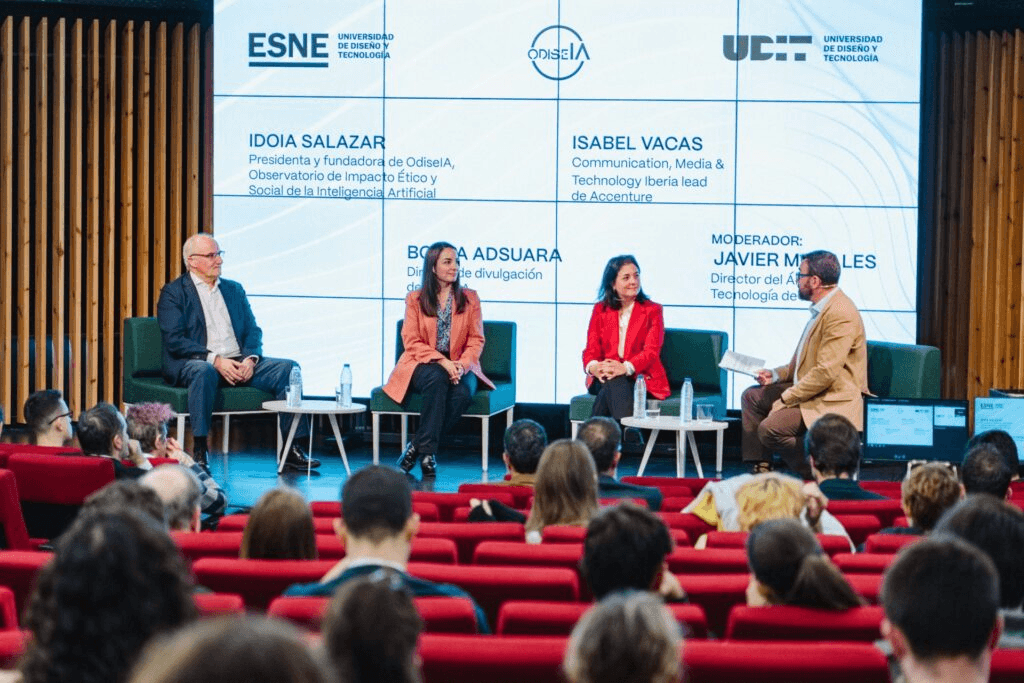
ESNE has held together with OdiseIA (Observatory of social and ethical impact of artificial intelligence) the round table "How Artificial Intelligence affects the creative professions".An event that was opened by Luis Calandre, academic director of ESNE, University of Design and Technology, and in which a group of renowned experts in the field composed by Idoia Salazar and Borja Adsuara from OdiseIA, and Isabel Vacas, from Accenture, and moderated by Javier Morales, director of the Technology Area of ESNE, discussed and discussed the impact that this new technology can have on design and creativity as well as the importance of a correct use adjusted to a mandatory regulation that preserves the welfare and minimizes the risks that it can bring to the user.
Idoia Salazar, president and founder of OdiseIA, began her speech by explaining the reasons why the Observatory on the social and ethical impact of Artificial Intelligence was created. In her words, "it was born with the idea of helping institutions and companies to create and use artificial intelligences in the service of humans, avoiding unethical uses or uses that go against people's interests".
In addition, throughout the meeting, he clarified to the students attending the impact that AI would have on their activity as designers, to which Salazar responded to one of the students that "some professions will disappear and others will be transformed, but it is impossible to predict what will happen with each one in particular, what I recommend is that you learn as much as possible about how AI can help you and create your own definition of your profession".
Isabel Vacas, director of data and artificial intelligence (AI) at Accenture, highlighted several recent trends in the field of AI and how Accenture is helping clients differentiate themselves through AI. In her presentation, Vacas noted that 2022 was the year of AI, which has seen several significant advances in deep learning, sharing several examples of generative AI. He also highlighted the importance of explanatory AI, which allows humans to understand how an AI model works and how it makes its decisions.
Finally, he emphasised the democratisation of AI and how, for example, chatGPT allows more people to experiment with AI and discover its possibilities, which can lead to the creation of new AI-based applications and solutions in a wide variety of sectors.
On the other hand, he shared the results of an Accenture study revealing that 75% of companies have already integrated AI into their business strategies and how the average number of AI capabilities used by organisations, such as natural language generation and computer vision, have doubled. In terms of AI use cases in different industries, Isabel Vacas mentioned the development of a fraud detection system in the financial industry, an automated diagnostic system in healthcare, drones and AI-powered computer vision to monitor equipment and remote locations in the technology industry, as well as a route planning system in the logistics industry.
In short, the director of data and artificial intelligence (AI) at Accenture is clear that we are experiencing a major turning point and that there will be a before and after in the world of applied AI.For his part, lawyer Borja Adsuara pointed out that "the most important thing about creative or generative Artificial Intelligences is that they force people to rethink what Art is, what intellectual creation is and what is the value protected by intellectual property rights. Copying or plagiarism is one thing, 'inspiration' from other works and authors is another, which is what artists have always done. Should AI companies have to pay for it? And what about artists who are inspired by others? But, above all, how can it be proved if there are no recognisable coincidences? For Adsuara, "instead of considering them enemies, artists are in a better position than anyone else to use creative or generative artificial intelligences".
Finally, Javier Morales, director of the Technology Area at ESNE, is clear that holding initiatives such as "this round table on 'How AI affects the creative professions', at UDIT, as auniversity specialising in Design and Technology, and within technology specialising in Artificial Intelligence, puts us in an incomparable position to lead this area of AI application".
Morales also confirms that "UDIT's technology area is positioned as a benchmark in the rigorous training of future engineers who will combine the most technical part of this profession with creative, humanistic and innovative skills.
We firmly believe that the engineering of the future must be people-oriented and put future technologies at the service of humanity".
This event was the first joint collaboration between the University of Design and Technology and the Observatory on the Social and Ethical Impact of Artificial Intelligence OdiseIA, which it recently joined.