


Inscripciones Abiertas
Official Bachelor’s Degree in Full-Stack Development
The logical evolution of computer engineering into a real-world-focused degree.
Master software development and lead the technological revolution. Train in the most complete and advanced way: our goal is to train the leaders of technology.

Imagen que muestra líneas de código y datos en un entorno digital con luces azules.
THE ESSENTIALS
Key Data
If you want to know more, you can fill in this form and we will contact you as soon as possible. We will send you the official brochure, where you will find all the detailed information about the programme, the curriculum, career opportunities, the admission process and much more so that you can make the best decision.
- CampusTecnología, Innovación y Ciencias Aplicadas
- LanguagesSpanish
- ModalityOn-campus
- CertificationOficial
- Duration4 años
- Credits240 ECTS
- Starts On01/09/2027
- Schedule1º y 2º Curso (mañana), 3º y 4º (tarde).
- Seats70
- Professional PracticesIncluded and guaranteed
- Technology and SoftwareOfficial licences included
- Business connectionReal projects supervised by companies
Do you want to know more?
OVERVIEW
The first official degree in Spain specialized in Full-Stack Development. A pioneering program designed to respond to an increasingly evident reality, the world needs professionals capable of designing, developing, and maintaining the software that drives the digital transformation of businesses, products, and services. From mobile applications and web platforms to intelligent cloud-connected systems, software development has become one of the most in-demand and future-proof professions. Today, understanding technology is no longer enough, companies are looking for professionals who can build it, lead projects, and turn ideas into real-world solutions.
Unlike a traditional Computer Engineering degree, which is broader in scope and covers multiple areas of knowledge, this program is specifically designed to train specialists in software development from a holistic perspective. You will learn to work across every layer of a technology project, mastering front-end and back-end development, databases, cloud architectures, mobile development, APIs, DevOps, and Artificial Intelligence. All of this is delivered through a highly practical approach aligned with the technologies, methodologies, and tools currently used across the industry. Because the developer of the future understands the product, collaborates effectively within teams, and can build end-to-end solutions from concept to deployment.
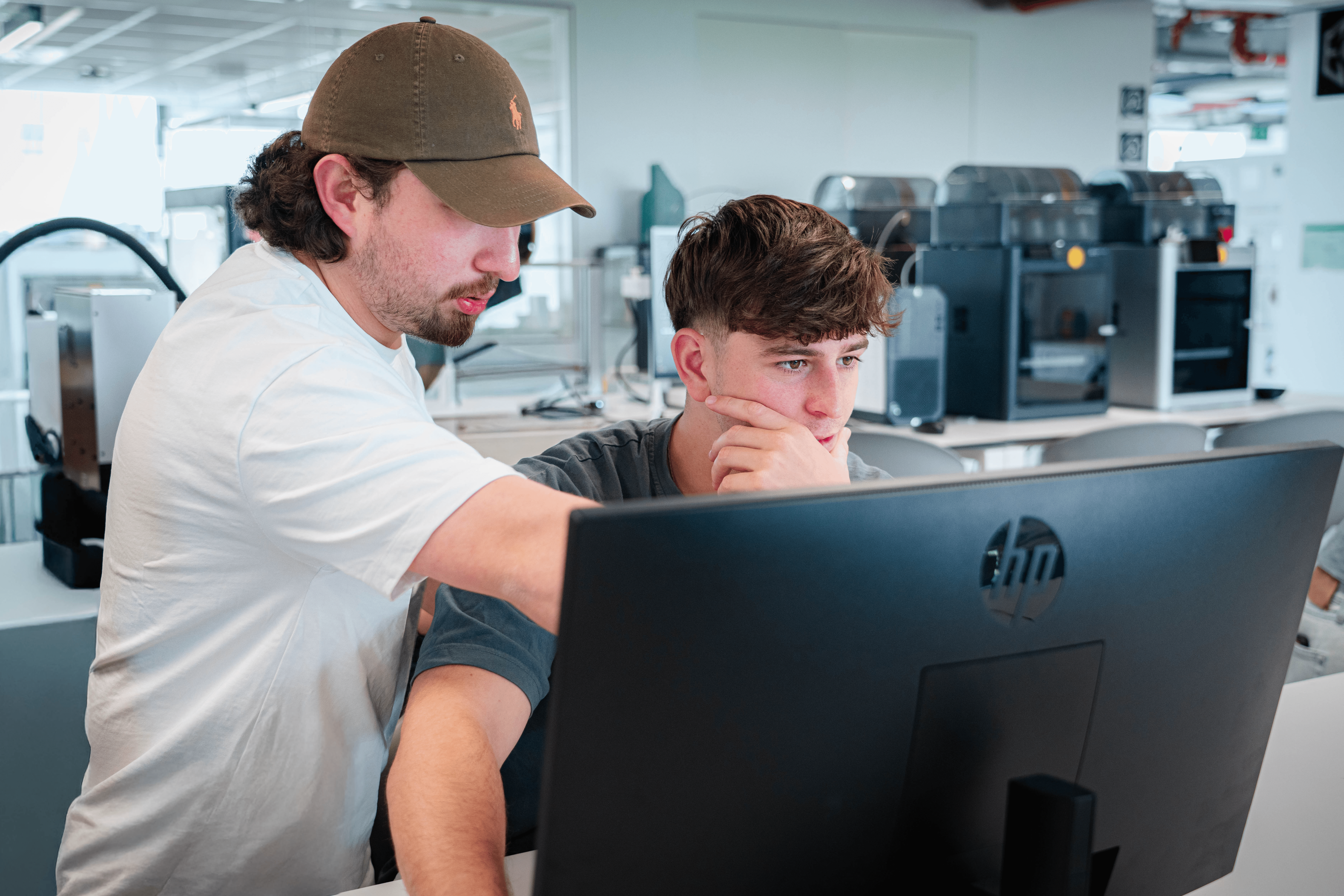
At UDIT, you will learn by doing from day one, developing real-world projects in environments that replicate the dynamics of technology companies. You will work in teams, tackle challenges connected to professional realities, and build a portfolio that showcases your ability to create innovative solutions. In addition, you will become part of a unique ecosystem of innovation and technology, with access to internships, direct contact with companies, industry-active faculty, and personalized support throughout your academic journey. Because at UDIT, we believe that Full-Stack Development is learned by building it.
WHY UDIT

At UDIT, you will study in small groups, with close monitoring and continuous support from professors and academic staff who will follow your progress and help you reach your full potential. A more personalized university experience, where you will receive real guidance, ongoing feedback, and support throughout your academic and professional journey, enabling you to make the most of your talent.

What is Full-Stack, and Why Was This Degree Created?
The term Full-Stack refers to a type of software developer who has a comprehensive understanding of the entire software development process. This broad perspective covers everything from application design to final implementation, involving a wide range of technologies and tools, including databases, servers, network maintenance, cybersecurity, artificial intelligence, user interface design, and the deployment of the final solution.
A Full-Stack Developer is proficient in both back-end and front-end development. The back end encompasses the components that operate behind the scenes and support the application, such as databases, servers, and business logic. The front end includes everything users see and interact with on their screens, such as navigation menus, forms, and controls.This versatility enables Full-Stack professionals to manage technology projects from start to finish, overseeing every stage of the development lifecycle.

STUDY PLAN
Syllabus
Programming Languages and Software Tools


faculty

Programme Director
Fernando Blázquez Piñeiro
Director of the Degree in Full-Stack Development and the Degree in Data Science and Artificial Intelligence. Degree in Physics (specialising in Automatic Calculus) from the Complutense University of Madrid, with a Diploma of Advanced Studies from the School of Computer Engineering of the UNED.
meet the faculty


Career opportunities
- Back-End Designer and Developer (Server-Side)
- Front-End Designer and Developer (Client-Side)
- Technology Consultant
- Software Maintenance and Debugging Specialist
- Software Project Manager
- Software Testing Developer / QA Engineer
- Systems Analyst
- Web Analytics Specialist
- Web Developer
- Blockchain Technology and Decentralized Applications (DApps) Consultant
- DevOps and Process Automation Specialist
- Database Designer and Developer
INDUSTRY CONNECTIONS
+2.400 PARTNERSHIPS WITH LEADING COMPANIES WORLDSWDE
At UDIT, internships are an integral part of the academic curriculum and are guaranteed for every student. We work closely with companies and institutions to connect you with the professional world and help you build meaningful industry experience from the very beginning of your university journey.


STRATEGIC LINKS


UNIQUE EXPERIENCES
FACILITIES

Programming classrooms
Workspaces equipped with Wacom Cintiq 22” graphic tablets, high-performance workstations, and professional software, designed for developing and visualizing your product design projects. An environment where you can ideate, model, and refine your concepts with precision, integrating creativity and technology at every stage of the process.

ADVANCED SOFTWARES
You will have the opportunity to become certified as an expert in SolidWorks, mastering one of the leading mechanical design software tools for 2D and 3D modeling.

PROTOSPACE
A space of more than 1,000 m' where students develop their projects from idea to prototype. An environment designed to work, test and improve solutions in real conditions. It is part of the international network of laboratories promoted by Airbus.


MAKER LAB
A workshop space where you can work with real materials and processes. From woodworking machinery and physical manufacturing processes to advanced prototyping technologies such as 3D printing, laser cutting, CNC or welding and electronics equipment, here your ideas are built, tested and turned into objects from the very first moment.
WE DO NOT SAY SO OURSELVES
+400
International awards won in recent years by our students.
90%
Leading to employability in one of the most in-demand professional profiles among companies.
1º
National Design Award and recipient of the Education & Training Award at the Madrid Open Cities Awards.
5★QS
Top score in teaching quality and employability in the international QS ranking.
frequently asked questions
Because at UDIT we offer you a unique and winning methodology, based on creativity, new and current study plans, the incorporation of technology and innovation as the backbone, training based on real projects and critical thinking driven by the teaching staff.
The market currently demands professionals capable of designing, developing and maintaining software applications and systems that respond to the needs of companies and users. This degree is aimed at those who want to work in high-performance multinational environments as software developers.
You will acquire core knowledge that will train you as a software developer, mastering front-end and back-end, professional cloud technologies and systems, and deployment with a focus on cybersecurity and emerging technologies (blockchain and DeFi), as well as designing for different devices and platforms (web design, interfaces and interaction, user experience, etc.).
Some of the skills taught in the programme, divided by areas, are:
FRONT END DEVELOPMENT
- Responsive Design. Techniques to ensure that applications work and look good on any device.
- Style sheets. Use of style systems to control the visual design and layout of web elements.
- Accessibility. Making applications accessible to users with different abilities.
- Interface design and user experience (UX). Ensuring that applications are intuitive and easy to use, as well as clear and attractive.
- Client-side programming. Client-side programming languages to create interactivity in applications.
BACK END DEVELOPMENT
- Server-side programming. Server-side programming languages to develop the logic and functionality of applications.
- Databases. Database management to store, retrieve and manipulate the data with which applications work.
- Web security. Techniques and strategies to protect web applications from vulnerabilities and attacks.
- APIs. Creation and use of APIs to enable communication between different systems and services.
TRANSVERSAL KNOWLEDGE OF SOFTWARE DEVELOPMENT
- Principles of agile development. Agile methodologies for software development, promoting rapid iteration and flexible response to change.
- Deployment and operations. Deployment of applications on servers.
- Software testing and debugging. Ensuring the quality and stability of applications.
- Version control. Techniques for managing code changes and collaboration within a software development team.
Several programming languages will be used, including C++, Python or R, together with their most used libraries.
You will learn to use the main development environments and technologies, such as Express.js, Apache, Node.js or Visual Studio.
Software tools such as SQL, MongoDB, MATLAB or SPSS.
Yes, Agile methodologies are used today in most technology companies, so they are taught throughout the degree. These methodologies are integrated into the students' projects.
Yes, all degrees offered at UDIT are official and internationally recognised.
You should be careful with other degrees offered on the market as "Official Degrees" which, in reality, are not. To check if a degree is official, you should consult the website of the RUCT (Registry of Universities, Centres and Degrees), an official body belonging to the Ministry of Universities that oversees academic organisation and university officialdom.
If you come from the Spanish education system, to study this Degree at UDIT you must meet at least one of the following requirements:
- Having passed the University Entrance Examination (EVAU) with a pass mark.
- Students coming from a Higher Level Training Cycle or FP II.
- Students accessing from completed Spanish university studies.
- Students accessing through the University Entrance Examination for over 25, 40 or 45 year olds.
Students coming from educational systems outside Spain:
- Students coming from pre-university education systems of European Union member states and countries with reciprocity agreements.
- Students in possession of the International Baccalaureate Diploma.
- Students coming from foreign pre-university education systems.
- Students with foreign university studies who access through the homologation of their studies.
- Students with official foreign university studies, completed or unfinished, who gain access through official validation.
All our Bachelor's Degrees start from scratch, so it is not necessary to have taken a specific type of baccalaureate.
It is true that, due to the type of our degrees, it is usually recommended to take a bachelor's degree in science and technology, with special attention to subjects such as Mathematics and, if possible, having studied subjects related to Computer Science, Programming, Computing and Technology in general.
Although not essential, previous experience in programming and participation in personal software development projects is a significant added value.
If you want to study the Bachelor's Degree in Full-Stack Development, you can do so without having taken a specific baccalaureate; you must meet the entry requirements set out in art. 3 of Royal Decree 412/2014. However, the recommended entry profile is that of a student with a strong affinity for technology, an outstanding performance in mathematics and a strong interest in problem solving.
Ideally, you should have a Bachelor's degree in Science and Technology, paying special attention to subjects such as Mathematics and, if possible, having studied subjects related to Computer Science, Programming, Computing and Technology in general.
When you take the Degree in Full-Stack Development, we provide you with access to the exam that allows you to obtain the Microsoft Azure Fundamentals certificate.
- Azure AI Fundamentals: allows you to achieve the first level in the path generated by Microsoft for Artificial Intelligence engineers. It provides an overview of the implementation of the main AI algorithms in Azure.
The first step is to request information; you can do this via the web, by telephone on 91 555 25 28 or by email: orientacion.universitaria@udit.es.
The next step is to take the level test, the aim of which is to find out the student's academic skills, allowing you to detect reinforcement actions before the start of the course.
Once you have taken the test and have been informed that you have been admitted to UDIT, make a registration reservation to guarantee your place for the next course. Places are allocated on a first-come, first-served basis.
Of course, by offering you an official Bachelor's degree, you can apply for all the public grants for this type of degree. Moreover, official scholarships are compatible with our internal study grants. If you have a good academic record or if creativity is part of your DNA, don't hesitate to apply for all of them. You can check the details on this link.
If you are passionate about technology and want to become a software development professional, our Full-Stack Software Development Degree is the perfect choice. This programme covers the fundamentals of development, from basic programming to the creation of complex applications and embedded systems. With a hands-on approach and a constant connection to industry, our students acquire the skills needed to excel in the competitive world of software.
UDIT is your best choice to study software development in Spain. Our campus is strategically located on Calle Alcalá, one of Madrid's main thoroughfares, and offers state-of-the-art facilities, including 7,000 new square meters dedicated to Technology, Innovation and Applied Sciences. Our programme focuses not only on academic excellence, but also on providing you with transformative experiences and connecting you with the most cutting-edge companies in the sector.
The salary of a Full-Stack web developer in Spain can vary depending on experience and location, but on average, a professional in this field can expect to earn between 30,000 and 50,000 euros per year. In cities such as Madrid and Barcelona, salaries can be even more competitive due to the high demand for advanced technological skills.
Becoming a full stack developer can vary depending on the pace of study and dedication of the student. In general, our Full-Stack Development Degree lasts four years, during which you will acquire in-depth knowledge in front-end and back-end, as well as database skills and agile methodologies. This programme is designed to prepare you comprehensively, allowing you to enter the job market with confidence.
QUALITY ASSURANCE
Internal Quality Assurance System (IQAS)
No. of places Degree in Full-Stack Development: 70
Documents of Interest
Admission Process
Just follow these four simple steps
Request Information
Fill in the following form, call us on 91 555 25 28 or write to us at orientacion.universitaria@udit.es and solve all your doubts about the qualifications you are most interested in.
Come and visit us
Arrange a visit to our Madrid campus from Monday to Friday from 10.00 am to 6.00 pm, sign up for the Open Days we hold on Saturdays or the online information sessions.
Admission process:
University Degrees: to guarantee the best match between your profile and the degree chosen, the admission process includes two tests:
- Psychopedagogical test
- Personal interview with the academic department of the degree
Formalise your registration
Once you have taken the test and have been informed of your admission to UDIT, you must book your enrolment to guarantee your place for the next course. Places are allocated on a first come, first served basis.
NEWSLETTER
Be part of the creative network that is transforming design, technology and education.
Get news, events, launches and opportunities from the UDIT universe before anyone else. For inquiring minds looking to go one step further.