
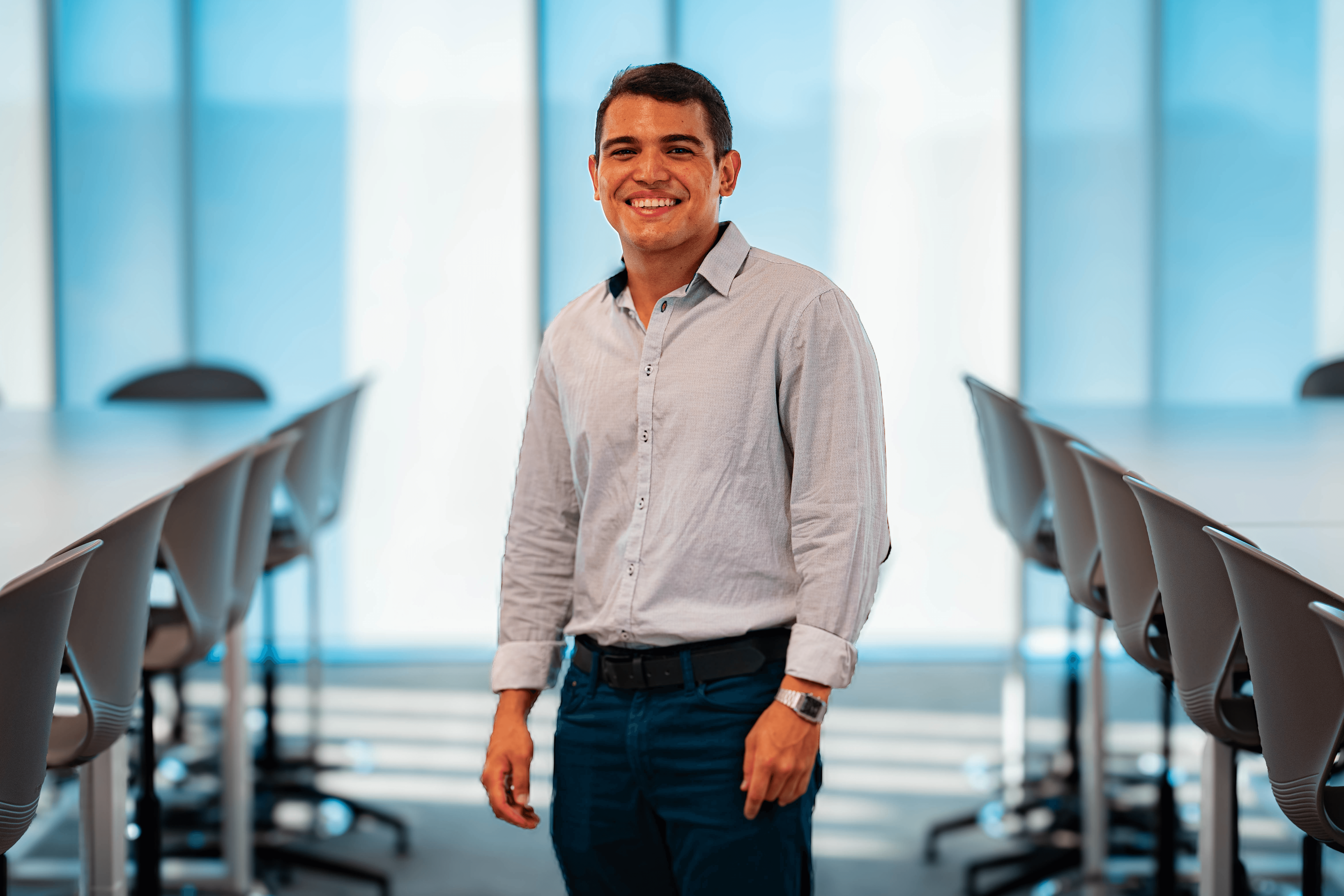
Un joven sonriente se encuentra de pie en una sala de reuniones con paneles de vidrio.

UDIT alumnus develops AI tool to boost business cooperation

  • 6 October 2025
  • 3 minutos
  • Blog

One of the great challenges in today's technological ecosystems is to identify opportunities for collaboration between agents with diverse profiles. This need was the starting point for the Master's Thesis of Yannick José Medina, alumni of the Master in Artificial Intelligence at UDIT, who developed an innovative solution for Secpho, a cluster of companies specialised in DeepTech. His proposal: a conversational recommendation system based on artificial intelligence that facilitates and speeds up the connection between partners. 

The result is a conversational recommendation system, capable of interpreting descriptions written in natural language and generating personalised collaboration proposals.  "The idea came about because the number of partners at Secpho has grown a lot in recent years. Finding partners for technology projects now takes more time, as there are more options. A recommendation system helps to make this process faster and allows time to be spent on other important tasks," explains Yannick. 

The developed system relies on large-scale language models, such as OpenAI's GPT-4, and uses vector databases to perform advanced semantic searches. It is divided into two modules: one in charge of transforming user requests into actionable representations, and another that performs profile recommendation through machine learning techniques. This combination has led to 89% accuracy in identifying suitable partners from freely described technological challenges. 

"The goal was to facilitate meaningful connections, even in very diverse contexts, from technical collaborations to more informal affinities," he says. "With this project, I wanted to apply artificial intelligence to help create those connections more easily and effectively."


During the process, Yannick delved into key areas such as vector searches: "I learned a lot about vector databases and how to do semantic searches using various vectors and filters. It was a new topic for me and very useful to improve the system. 

Beyond the technical dimension, the project highlights how AI can serve as a bridge between people."I work as a data scientist, and that experience has given me the tools to develop AI solutions, but also to understand how they can help connect people and facilitate collaboration," he says. 

His time at UDIT was essential in putting this approach into practice. "I'm interested in AI because it can solve complex tasks by learning from data. There are things that would be very difficult to programme with fixed rules, and AI makes this possible. 

With an eye on the future, Yannick is clear about the purpose guiding his career: "I would like to continue developing AI solutions that help people work better, save time and focus on more important tasks. I want to create useful tools that make life easier". 

Yannick's case is an example of how the projects that emerge from UDIT's Master in Artificial Intelligence have a real value for industry and society, responding to concrete needs with innovative solutions. 

  • Ciencia y Tecnología

RELATED INSIGHTS

Una clase de animación donde los estudiantes trabajan en sus computadoras.
Animación

What makes an animated scene work: visual storytelling, pacing and performance

16 October 2026

An animated scene works narratively when its visual and temporal choices enable the audience to understand the action, interpret the characters’ intentions and recognise how a situation is changing. Achieving this involves visual storytelling, framing, performance and pacing, as well as the technical resources that make it possible to depict them. It is not enough simply to produce fluid movements or expressive characters: what matters is what information the viewer receives, where their attention is directed, and when what is happening on screen begins to make sense.

Una persona organiza una serie de objetos de diseño con elementos de papelería y fotografías sobre una mesa.
Branding & Creación gráfica

Visual identity: what makes a brand recognisable beyond its logo

14 October 2026

Visual identity brings together the symbols, elements and graphic relationships that enable a brand’s presence to be articulated across various media. Although consistency is often equated with the systematic repetition of a single aesthetic formula, identity design operates according to a different logic. Maintaining visual continuity does not mean imposing an unchanging graphic uniformity, but rather structuring a system of formal criteria capable of adapting to different formats, scales and communicative functions without losing continuity across its applications.

Una mujer joven está cortando tela en un entorno de clase de costura.
Moda

What it means to specialise in fashion marketing and communication: strategy, branding and activation

2 October 2026

Fashion marketing and communication involve rigorously applying the fundamentals of strategy, consumer behaviour, branding and business to a sector governed by cultural codes, intermediaries and unique shopping experiences. Specialising does not mean simply accumulating channels or technical tools, but rather developing the necessary judgement to define a solid positioning, articulate coherent narratives to diverse audiences, link visual identity with the shopping experience, and assess the real impact of every decision.

Un grupo de estudiantes sentados en un aula prestando atención.
Videojuegos, Branding, Interiores, Creación gráfica, Producto, Ciencia y Tecnología, Moda, Animación & UX

How to tell if a creative or tech career is right for you: take a look at the work that goes into it

30 September 2026

To find out whether a degree course is right for you, it is not enough simply to ask yourself whether you like the outcomes. It’s worth finding out which tasks recur during your studies and in your work, what difficulties are part of the process, what problems arise in the curriculum, and what projects you’ll need to learn to tackle. Making a better choice means replacing an idealised image of the profession with evidence that’s closer to how the work is actually done.

Un grupo de jóvenes prestando atención en un aula moderna.
Ciencia y Tecnología

What goes on behind the scenes: software, data and artificial intelligence within a digital product

25 September 2026

A simple function within an app may depend on dozens of invisible components. The software receives an action and executes logic; the data reveals what is happening and what happened previously; and, when the problem requires predicting, classifying, recommending or generating a response, an artificial intelligence model may come into play. Understanding a digital product requires distinguishing between these layers and, above all, understanding how they depend on one another.

Una moderna sala de estar con un diseño elegante y amplios espacios abiertos.
Interiores

A space is understood when it comes into use: its function, atmosphere, physical qualities and the experience it offers

23 September 2026

An interior may appear perfectly resolved on a plan or in a rendering, yet behave very differently once it is put into use. People introduce movement patterns, timetables, noise, objects, maintenance and needs that the final image does not show. That is why designing a space requires relating its function, circulation, atmosphere and materials to something far less static: the life that will take place within it.

Una persona está dibujando en una pantalla digital con un stylus.
Creación gráfica

Graphic design, audiovisual design, illustration and branding: four ways of tackling the same brief

18 September 2026

Visual communication may draw on graphic design, audiovisual media, illustration or branding to construct meaning, but each discipline plays a different role. Graphic design organises information and visual relationships; audiovisual design adds time and sound; illustration interprets an idea through constructed images; and branding establishes the system that enables meaning and recognition to be maintained across different elements and touchpoints.