


UDIT to improve Telefónica's commercial training with Artificial Intelligence
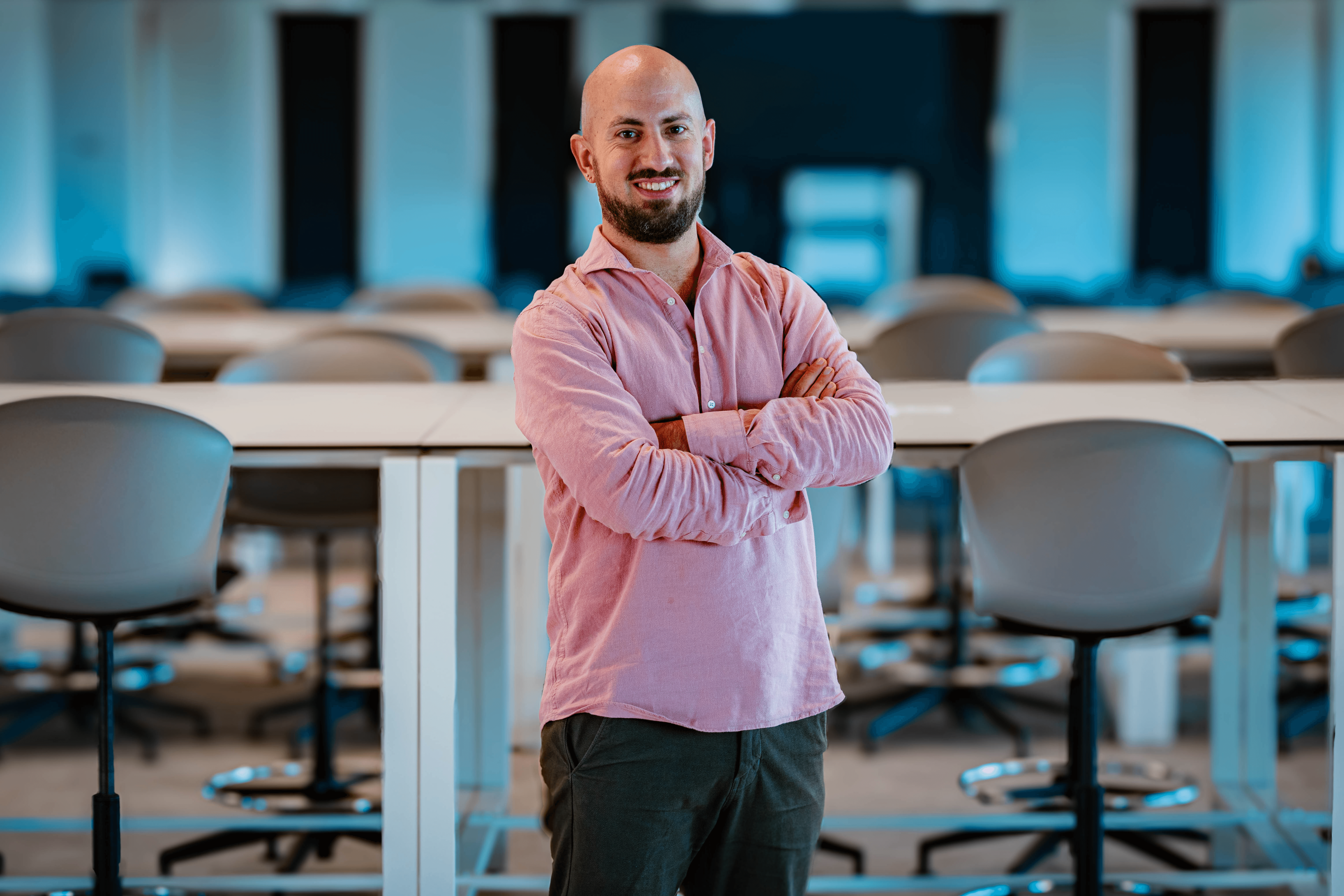
Aldo Egea is one of the students who in the last year have successfully completed the Master's Degree in Artificial Intelligence at UDIT, University of Design, Innovation and Technology. In collaboration with Telefónica, he has developed, as part of his master's degree final project, a project consisting of the design of an interactive solution based on AI to train the commercial competences and skills of Telefónica's sales teams, through a simulation or roleplay between a salesperson (the student) and his virtual client (the AI).
This project, conceived to train Telefónica's sales teams, has had a great impact on the company's training methodology since, as Egea himself explains, "it has allowed a new learning paradigm to be established: more flexible, multidisciplinary and efficient".
He also highlights the value of having been able to apply his project in a real business environment, combining his previous professional experience with the knowledge acquired at UDIT, which has allowed him to develop a tool with a tangible impact on one of the leading companies in the technology sector.
How exactly does the simulation between the salesperson and the AI work, and what kind of interaction do you want to replicate?
The tool makes it possible to simulate a first meeting with a customer who already has contracted products, and to whom new value propositions are presented. The interaction can be carried out both in writing and by voice, which makes it possible to adapt the format to different training situations.
Once the conversation is over, a specialised agent analyses the salesperson's performance in depth, identifies successes and areas for improvement, and provides personalised recommendations to optimise future interactions.
This project has been developed specifically for the B2B sales teams of Telefónica, the company where I currently work, and represents a real example of the application of artificial intelligence to the development of talent in business contexts.
In the development of the project you incorporated an analysis of the practices of the best salespeople. What value did it add? What did you learn during this analysis phase?
I think this has been fundamental in defining the script of the roleplay and, above all, in choosing the evaluation criteria. In the end, when you want the entire sales force to follow in the footsteps of the "best performers", it is necessary to evaluate their performance on the basis of this behaviour.
It is also true that "every man for himself" and, sometimes, what works for one salesperson does not necessarily work for another. But it is not a question of replicating their colleagues step by step, but of encouraging them to make the methodology their own, internalise it and apply it naturally.
How do you measure user performance during the simulation, and what metrics or indicators have you prioritised?
At the end of the simulation there is an evaluation process where we analyse whether the conversation meets a series of criteria .
These criteria are agreed with a team of educationalists and business experts to ensure that they are in line with both the generic theory of consultative selling and the best practices identified during the "consultancy" phase and, of course, also taking into account the different sales arguments defined for each of the company's products.
What motivated you to focus your TFM on the intersection between artificial intelligence and sales skills training?
In 2021 I joined Telefónica's Global B2B team, an area dedicated to supporting B2B business units at an international level, with a specific focus on the development of commercial skills and technological knowledge.
As part of this initiative, we work with different levers to boost the excellence of our sales force, from training programmes and multimedia content (such as the "B2B Sales Podcast") to innovation projects such as the one I have developed.
Developing a tool of this type allows us to establish a new training paradigm in the company, facilitating multidisciplinary, more flexible learning that "engages" students and helps them, in short, to learn in a more efficient way.
What does working for a company like Telefónica mean to you, and how has its methodology influenced the development of the project?
Working at Telefónica has given me the opportunity to develop this innovation project in a real use case, fully aligned with the needs of the business. It has been an experience that has allowed me to integrate my previous knowledge of corporate training and commercial strategy with the skills acquired in artificial intelligence during the master's degree, thus generating a solution with direct application and tangible value for the company.
In addition, Telefónica is a leading company in technology and the development of young talent, so I have all the innovations, skills and means at my disposal to develop professionally and carry out this type of transformational project.
Do you think it is feasible that this solution could be applied to other teams or sectors outside the telecommunications sector?
Of course it could. Any company, regardless of the sector, could use it to train their sales team and train skills such as, for example, effective communication, complaint management or product knowledge.
On the other hand, beyond sales teams, it would also be very effective for support teams, customer service or other groups where they could simulate conversations that they encounter in their day-to-day work: the more realistic the roleplayis , the easier it will be to transfer the knowledge acquired in practical training to our workplace.
If we add the flexibility offered by AI to handle natural conversations, adapt new use cases, manage different languages, etc., we are talking about a very powerful tool for all types of companies.
How would you like to continue developing this type of AI-based solutions in your career?
Based on this project, we plan to launch a pilot with Telefónica sales teams, initially in Spain and Germany, as a preliminary step to a possible global roll-out across the entire sales network.
Beyond the immediate usefulness of the simulation, the real value lies in the analysis of the data generated. This approach makes it possible not only to measure the direct impact on sales performance, sales efficiency and customer satisfaction, but also to identify specific skills gaps in the team.
For example, if it is detected that professionals have difficulties in handling objections, specific training interventions can be designed to reinforce this competence and thus improve their overall performance.
What role do you think artificial intelligence can play in soft skills training and assessment in the coming years?
I think it will be crucial. I am already seeing courses created entirely withAI, videos perfectly dubbed into other languages thanks to automatic translation solutions and interactive practical exercises, such as this one, which open up an incredible number of possible scenarios.
The challenge is to ensure that this is done rigorously and with people at the centre: it is very easy to get lost in the "wow effect" of this type of technology, but we must not forget that the priority must be the usefulness for the learners and for the business. Besides, what could be more wow than having a real impact on the performance of your colleagues and enriching business data and its analysis?


